 |
     Hospitality from the Heart Spectacular Viewpoints The Top Camp Resorts |
Historical Sites
Temple >>
Wat Yai Chaimongkol (Ayutthaya) 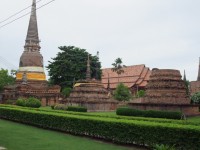 Wat Yai Chaimongkol, located southeast of the historical town, was built in 1357 by King U-Thong for monks who came back home from their Pali studies in Ceylon. The original name of this temple was Wat Chao Phaya Thai. After the victory over the Burmese, King Naresuan constructed the almost 60 m tall Phra Chai Mongkol Chedi in gratitude and memory of his triumph. Since then, the temple received the name Wat Yai Chaimongkol. Wat Yai Chaimongkol, located southeast of the historical town, was built in 1357 by King U-Thong for monks who came back home from their Pali studies in Ceylon. The original name of this temple was Wat Chao Phaya Thai. After the victory over the Burmese, King Naresuan constructed the almost 60 m tall Phra Chai Mongkol Chedi in gratitude and memory of his triumph. Since then, the temple received the name Wat Yai Chaimongkol. Ruins >>
Wat Phu Khao Thong (Ayutthaya) 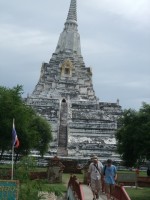 The history of Wat Phu Khao Thong, which is located about two kilometers northwest of the town, is as change full as the history of Ayutthaya itself. The temple was built in 1387 during the reign of King Ramesuan. Shortly after the invasion of the Burmese in 1589, the temple buildings were destroyed and the Burmese constructed a large Mon-style Chedi. In the course of time it gradually deteriorated as the invaders were expelled. In 1745, King Boromakot ordered the construction of a new temple tower in Ayutthaya style which was built on the base of the former one. The history of Wat Phu Khao Thong, which is located about two kilometers northwest of the town, is as change full as the history of Ayutthaya itself. The temple was built in 1387 during the reign of King Ramesuan. Shortly after the invasion of the Burmese in 1589, the temple buildings were destroyed and the Burmese constructed a large Mon-style Chedi. In the course of time it gradually deteriorated as the invaders were expelled. In 1745, King Boromakot ordered the construction of a new temple tower in Ayutthaya style which was built on the base of the former one. Statue >>
Wat Lokaya Sutha (Ayutthaya) 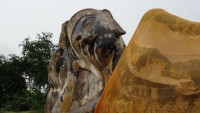 During the attack of Burmese troops, the Viharn of Wat Lokayasutha was burnt down and since then, the Buddha image can be found in the open air: a 28 meter-long reclining stucco Buddha statue from the mid-Ayutthaya era. During the attack of Burmese troops, the Viharn of Wat Lokayasutha was burnt down and since then, the Buddha image can be found in the open air: a 28 meter-long reclining stucco Buddha statue from the mid-Ayutthaya era. Temple >>
Wat Panan Choeng (Ayutthaya) 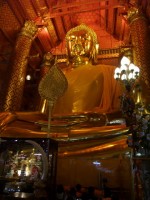 Archaeologists believe that Wat Panan Choeng which is important for many Thais, was built 26 years prior to the foundation of the city by King U-Thong. The 19-meter tall Buddha statue has been completely restored and newly gilded under the rule of King Mongkut. Archaeologists believe that Wat Panan Choeng which is important for many Thais, was built 26 years prior to the foundation of the city by King U-Thong. The 19-meter tall Buddha statue has been completely restored and newly gilded under the rule of King Mongkut. Temple >>
Wat Chai Watthanaram (Ayutthaya) 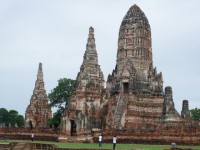 Ruins >>
Royal Palace (Ayutthaya) From the buildings of the first royal palace which was constructed by King U-Thong in 1350, only a few fragments of the walls remain. Nevertheless, the ruins of the second royal palace built by King Borom Trailokanat, the eighth ruler of Ayutthaya, in 1448 and extended by his successors, bear witness of the dimensions and the ancient splendor of this site. You can still see the remains of the entrance hall, San Phet Prasat, the halls of the ceremonies, Viharn Somdej and the columned hall, Chadravatphaichayon, where the Kings used to take the salute. Ayutthaya
Museum >>
Chao Sam Phraya National Museum (Chao Sam Phraya National Museum) (Ayutthaya) Phra Nakhon Si Ayutthaya is one of the most important historical cities of Thailand because it was the main capital of Thailand before Bangkok. As a result, there is much evidence of the achievements of the past that appear in the province, especially seen in the temple monuments. The site of the kingdom was like an island, being surrounded by rivers. When entering the territory of Phra Nakhon Si Ayutthaya, one is touched by the great view of different styles of stupas. They inspire our imagination to envision the grandeur of the Ayutthaya period. Many stupas are still in good condition due to continual preservation activities by the Fine Arts Department. The surrounding atmosphere reflects the past glory of the kingdom of Ayutthaya, which was an old kingdom of the Thais during the 14th-18th centuries A.D. The kingdom flourished in politics, administration and its economy. There were 36 kings from 5 dynasties. The kingdom remained in power for 417 years until losing a war to Burma (Myanmar at present) in 1767, when the kingdom was destroyed beyond repair and, as a result, the Thais moved south to the Bangkok area and established a new kingdom by 1782. There appears another special characteristic of Phra Nakhon Si Ayutthaya. The province intertwines the Thais way of life in the present, with the remnants of the past. Living in parallel with the past can sometimes cause many problems between preserving the past and developing the area at the same time. However, on many occasions, it has been rather successful in accomplishing a balance, between appreciation of life from the past while modernizing life in the present. Being a capital city of the kingdom for 417 years, Ayutthaya is surrounded by many monuments. In the compound of the city alone stand numerous structures belonging to different kings. Many ancient relics and art objects are found in the crypts of these monumental temples; they provide important evidence regarding the history, art and culture of the period. The most important discovery was in 1957, when a trove of golden treasures was found in a crypt of the ancient Wat Ratburana in 1424 where they remained unknown for over 500 years. When opened the crypt contained forms of stupas, jewelry, and miniature regalia. They were assumed to be made by Somdet Phra Boromracha Thirat II (Chao Sam Phraya) as merit offerings for his two deceased brothers. The gold treasures had been put in the crypt of Wat Ratburana in 1424 where they remained unknown. Their discovery was one of the most important early historic archaeological works in Thailand. His Majesties the King and Queen paid a royal visit to the site to observe the treasures. They suggested building a museum for them as the heritage of the local people, to be located in Phra Nakhon Si Ayutthaya where the treasures were found. The Fine Arts Department established “Chao Sam Phraya National Museum” under His Majesty's instruction in the central part of the city. The museum was officially opened in 1961. The museum is considered the prototype of a true museum, built not only as a place for items of cultural heritage as in earlier museums, but for the purpose that a museum can also be an institution of learning. There was a plan for its construction from the beginning. Space in the museum had clearly been reserved for this future expansion. The buildings were built primarily with a proper plan for presentation of content and were divided into two structures. The first building in the front is the main exhibition area. The content is focused on the discovery of ancient objects in Phra Nakhon Si Ayutthaya and designed to be coherent with the atmosphere of the ancient monuments surrounding the area. The most important objects shown here are the Buddha relics found inside the crypt of Wat Maha. These relics prove that Buddhism was flourishing in the kingdom during the 15th - 18th centuries A.D. In fact, earlier period Buddha images found in different parts of the country also declare the widespread nature of Buddhism in Thailand. Rojana Rd., Ayutthaya |
New to t-Globe?
Register for free to get the full power of this web site!
Registered members will be able to: |
||||||||||||||||||||||||||||||||||||||||||||||||||||



|
|